




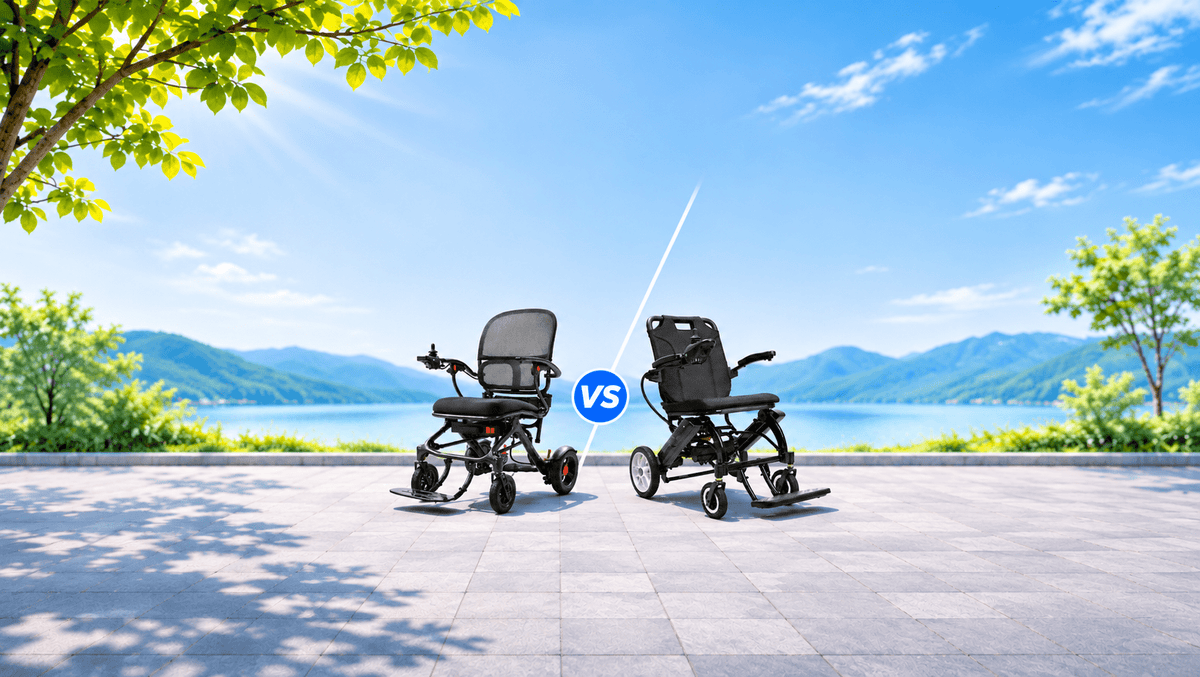
Carbon fiber vs. aluminum electric wheelchairs: which should you choose?
If getting your wheelchair in and out of the car is part of your weekly routine, a few pounds can make a real difference. But a carbon fiber frame is not automatically the better choice for everyone.
The right question is not simply “Which material is best?” It is: Which chair will be easier for you to live with, transport, and pay for?
Carbon fiber electric wheelchair pros and cons: what are the real trade-offs?
Carbon fiber combines reinforcing fibers with resin. Its benefits come from a well-designed composite structure; its drawbacks include a higher purchase price and sensitivity to concentrated impacts. Here is what that means for everyday use.
| Aspect | Concrete advantage | Concrete drawback |
|---|---|---|
| Handling weight | TIVARO lists EW7002 at 26 lb and EW5004 at 33 lb: a 7 lb difference in the published figures. Journey specifies its carbon Air Elite at 29 lb with battery versus 42 lb for its aluminum Air 2026. | Low weight does not make the folded chair disappear: EW7002 still occupies 23.62 × 13.78 × 29.53 in. Batteries and accessories must be counted when planning a lift. |
| Repeated loading | A well-engineered carbon laminate can withstand many repeated load cycles at low frame weight. The wheelchair study discussed below found better frame endurance for the carbon design tested. | A blow from dropping the frame against a trunk lip can split layers or break fibers. Resistance to repeated loads does not mean resistance to sharp impacts. |
| Purchase price | The lower transport weight is a tangible feature for frequent car trips. | The dated TIVARO prices below differ by $1,200. Journey’s Air Elite is $650 above its aluminum Air 2026. Carbon’s weight saving has a real upfront cost. |
| Repair after structural damage | An intact composite frame provides structural support with little material mass. | A damaged load-bearing tube requires an approved assessment and repair or replacement. Patching the visible surface does not establish that internal layers are sound. |
| Ride and seating | Engineers can tune stiffness through the fiber layout. | Frame stiffness does not provide powered tilt, pressure redistribution or suspension. Those require the relevant seat system, cushion or chassis components; carbon fiber is not a substitute. |
For occasional travel, the handling-weight advantage is easy to identify. For daily long-duration sitting, seat support and adjustments deserve equal attention: an expensive frame does not add functions that the chair does not have.
Will a folded carbon fiber electric wheelchair fit in a Toyota RAV4?
Both TIVARO chairs are smaller than the published cargo dimensions of a 2024 US-market RAV4 LE with the rear seats upright. Their folded shapes differ: EW7002 is a taller, narrower package; EW5004 is longer and flatter.
Toyota’s 2024 US RAV4 brochure, specifications page 27 lists 40.0 in of cargo length behind the rear seats, 39.4 in minimum cargo width, and 34.5 in minimum cargo height for the LE. These are interior cargo measurements, not the hatch opening.
| Measurement | 2024 RAV4 LE | EW7002 | EW5004 |
|---|---|---|---|
| Length / depth | 40.0 | 23.62 | 32.7 |
| Width | 39.4 (minimum) | 13.78 | 22.4 |
| Height | 34.5 (minimum) | 29.53 | 12.2 |
| Remaining length (subtraction) | — | 16.38 | 7.3 |
| Remaining width (subtraction) | — | 25.62 | 17.0 |
| Remaining height (subtraction) | — | 4.97 | 22.3 |
Using the listed L × W × H orientation, EW7002 has about 5 inches of vertical clearance inside this cargo space. EW5004 needs less vertical space but uses 9.08 inches more floor length. That is a useful distinction if you also carry groceries, a travel bag or another mobility aid.
Wheelchair dimensions come from TIVARO’s published model comparison. This is a dimensional calculation, not a physical loading test. The sloping hatch, wheel housings and loading path still need to clear the chair. The vehicle example is specifically the 2024 RAV4 LE; use measurements from your own model and trim.
How do you measure your own trunk before ordering?
- Measure the opening first: with the hatch fully open, measure the narrowest width along the intended loading path and the height from the cargo floor or sill to the upper trim. Keep the cargo mat in place.
- Measure the floor: with rear seats in their normal position, measure from the seatbacks to the closed-hatch boundary and between the wheel housings.
- Check the chair’s full envelope: include protruding wheels, folded footrests and joystick. Match length, width and height to the orientation you will actually use.
- Test before lifting: make a lightweight cardboard frame or box representing the folded dimensions, pass it through the hatch and check the hatch-closing path. A flat floor rectangle tests footprint only.
- Measure lifting height: measure from the ground to the trunk sill and plan the grip and loading position. Secure the unoccupied chair as cargo for driving.
For scale, RiDC’s separately measured 2019 RAV4 test vehicle had a 685 mm (27.0 in) ground-to-sill height. That UK test vehicle illustrates the lift required; it is not a measurement of the 2024 US LE. A shorter, lighter load still has to be raised to your own vehicle’s sill.
Use our electric wheelchair dimensions guide for the rest of the storage checklist.
Is carbon fiber more durable than aluminum—and what determines its durability?
Carbon fiber can deliver better frame fatigue endurance at low weight, but impact resistance is a separate property. Fatigue means damage from repeated loading; impact means a concentrated blow, such as hitting the frame against a curb or dropping it during loading.
Fiber direction and reinforcement determine how the frame carries loads
Carbon fibers carry loads most effectively along their length. Engineers arrange layers in different directions and reinforce high-load regions so a tube can resist the bending and twisting it encounters. The resin holds the fibers together and transfers load between them. This is why fiber orientation, layer placement and tube geometry matter more than the visible woven pattern.
Permobil’s frame-material explanation describes using different fiber arrangements in the back support, seat tubes and caster arms. The practical benefit is putting stiffness and reinforcement where each part needs it, without making the entire frame uniformly heavier.
Manufacturing quality and joints determine whether that design works
Fiber misalignment, internal voids and weak interfaces interrupt load transfer. NASA’s research on composite manufacturing defects identifies these as structural defects. On a folding wheelchair, hinges, locking mechanisms and component attachments also carry loads. A strong carbon tube does not compensate for a worn folding lock or loose attachment.
Impact damage changes the durability picture
A concentrated hit can crack the resin, break fibers or separate layers—a failure called delamination. TU Delft’s experimental research on impacted carbon composites shows that internal damage can be difficult to see and can grow under subsequent cyclic loading. Avoid using the frame as a contact point when dragging the chair over a trunk lip. Suspected structural impact damage needs manufacturer assessment before further use.
What does wheelchair testing actually show?
In a study published in Disability and Rehabilitation: Assistive Technology, researchers tested three full-carbon ultralight manual-wheelchair specimens against ANSI/RESNA procedures. The tested frames survived more cycles than the comparison wheelchairs, while casters and rear tires failed in similar ways. This supports carbon’s potential for frame fatigue endurance; it also shows that wheels and other components still limit whole-chair durability.
The buying conclusion: look for durability evidence for the finished chair, covering its frame and folding mechanisms under load. Carbon fiber’s fatigue advantage is credible engineering; a longer service life for a particular electric chair requires evidence for that design. The study above did not test either TIVARO model.
Which electric wheelchair parameters matter for your body weight and size?
1. Check weight capacity first, then measure the seat
Both models are advertised with a 300 lb capacity. Carbon fiber does not give EW7002 a higher published limit than EW5004. Being below 300 lb clears only the numerical capacity screen; it does not establish seat fit, posture or safe operation on slopes.
| User body weight | Capacity interpretation | Next check |
|---|---|---|
| 150 lb (68 kg) | 150 lb below the published limit. | Measure hips and thighs, seat depth and lower-leg length. A low body weight does not prove a narrow seat fits. |
| 250 lb (113 kg) | 50 lb below the published limit. | Check usable space between armrests, cushion width and the manufacturer’s rules for carried bags or equipment. |
| 290 lb (132 kg) | Only 10 lb below the published limit. | Account for carried equipment under the manufacturer’s load rules. If the permitted total would be exceeded, choose a higher-rated chair. |
| Over 300 lb (136 kg) | Exceeds the advertised capacity of both models. | Choose a model rated above the required load. Changing from aluminum to carbon fiber does not resolve this limit. |
The differences above are arithmetic, not an allowance for extra cargo or a recommended safety margin. Follow the selected model’s user manual for what counts toward its load limit. Do not invent a universal “20% spare capacity” rule.
2. Use body measurements to select seat width and depth
The Academy of Neurologic Physical Therapy measurement guide explains that seat width starts with seated hip breadth, while seat depth starts with the distance from the back of the hip to the knee. Its manual-wheelchair guidance allows 1¼–2 inches beyond hip breadth and subtracts 1–2 inches for seat depth. These are fitting starting points, not a prescription for every folding power chair.
Worked example: a seated hip breadth of 16 inches gives an initial seat-width range of 17¼–18 inches using that guide. A 17-inch listing therefore needs a careful fit trial rather than an automatic recommendation. Two people weighing 200 lb can have different hip widths and need different seats.
Measure usable space between armrests as well as cushion width. For depth, leave space behind the knees while supporting the thighs. The WHO wheelchair fitting training material likewise starts from hip breadth and thigh length and uses approximately 30–55 mm behind the knee in its measurement method. Lower-leg length determines the cushion-to-footrest relationship; cushion thickness changes the sitting height.
3. Check sitting support, transfers and control access
During a trial, check that both feet are supported, thighs are supported without pressure behind the knees, the armrests do not squeeze the hips, and the joystick can be operated without leaning forward or sideways. Test the transfer method you actually use. A wider nominal seat is not automatically a better fit.
If you cannot maintain an upright sitting position, have a history of pressure injuries, or require prescribed positioning or powered pressure relief, arrange a seating assessment before selecting a compact folding chair. A material upgrade does not replace those functions.

4. Compare range under the conditions you will actually use
The TIVARO homepage illustrates 15 miles for EW7002 and 30 miles for EW5004. Treat these as advertised model figures, not a shared-condition test or a promise for your route. Rider mass, gradients, surface and battery configuration affect energy use. Neither listing establishes the distance available to a 150 lb versus 250 lb rider.
For a useful comparison, ask for the selected battery’s watt-hours and the range-test rider load, surface and speed. Compare those with your daily route and charging opportunities. This is why carbon fiber’s lower listed weight cannot, by itself, establish longer range.
For doorway and vehicle checks, use our electric wheelchair dimensions guide.
How do the TIVARO EW7002 and EW5004 compare?


The EW7002 is TIVARO’s carbon fiber option; the EW5004 uses an aluminum-alloy frame. These are two different products, not a controlled test of materials.
| Detail | EW7002 | EW5004 |
|---|---|---|
| Frame | Carbon fiber | Aluminum alloy |
| Advertised selling price (October 27, 2026) | $1,899 | $699 |
| Listed weight | 26 lb | 33 lb |
| Published capacity | 300 lb | 300 lb |
| Seat width | 22 in | 17 in |
| Design | Foldable | Foldable |
TIVARO model specifications and advertised prices recorded October 27, 2026. EW7002 seat width: 22 in; EW5004 seat width: 17 in. Listed weight figures should be compared using the same battery and accessory conditions.
Start with the EW7002 if its lower listed weight addresses a transport problem you actually have. Include the EW5004 in your comparison if its fit, confirmed lifting load and current price meet your needs. Compare both against the same checklist before deciding.
Want to compare the two models?
Open both product pages, then confirm the lifting weight and seating measurements for your selected configuration.
How much do carbon fiber and aluminum electric wheelchairs cost?
The examples below span $699 to $2,699. Higher prices buy different combinations of low weight, seating adjustments, wheel sizes and removable components. They do not form a simple ladder from “weak” to “strong.”
| Model | Advertised price (USD) | What distinguishes the equipment |
|---|---|---|
| TIVARO EW5004 | $699 (Black Friday Sale) | Aluminum-alloy frame; listed 33 lb; 17 in seat; 4 in front and 7 in rear wheels. Entry-price option in this comparison. |
| TIVARO EW7002 | $1,699 (Black Friday Sale) | Carbon fiber; listed 26 lb; 22 in seat confirmed by TIVARO. Its listed weight is 7 lb below EW5004. |
| Journey Air 2026 | $1,995 | Aluminum; 39 lb without battery / 42 lb with; 300 lb capacity; dual brushless motors, 6.5 in front wheels, memory-foam cushion and USB charging. |
| Journey Air Elite | $2,645 | Carbon fiber; 26 lb without battery / 29 lb with; 240 lb capacity; dual brushless motors, reversible joystick and USB port. The clearest difference versus Air 2026 is 13 lb less battery-inclusive weight, with a lower capacity. |
| EZ Lite Cruiser Deluxe Regular DX12 | $2,699 | Manufacturer lists removable motors, a five-position reclining back, three-position armrest height, four-position footplate height and 12 in rear wheels. The upgrade emphasis is adjustability and component removal, not carbon fiber. |
Journey and EZ Lite Cruiser online prices checked October 28, 2026. TIVARO prices are the homepage figures recorded October 27, 2026. Prices are displayed selling prices before any additional tax, optional equipment or applicable delivery charge; they are not MSRP comparisons or market-wide price ranges. DX12 equipment details are on the manufacturer’s model page.
What are you paying extra for?
- Lower transport weight: Journey Air Elite is $650 above Air 2026 and 13 lb lighter with battery. The Elite’s stated capacity is 240 lb versus 300 lb, so the extra cost is not buying higher capacity.
- More adjustments: DX12’s reclining back, height-adjustable supports and removable motors provide identifiable hardware differences. These matter when a fixed seating position or a single heavy lifting piece is the problem.
- Different wheel and seat packages: wheel diameter, cushions and adjustment ranges change the equipment supplied. Compare those features directly rather than treating the frame material as the complete explanation for price.
For TIVARO, EW7002’s $1000 premium over EW5004 accompanies a lower listed weight and a different seat width. Choose it when those differences address your transport and fit needs. The listed 26 lb and 33 lb figures do not establish identical battery-inclusive lifting conditions, so they should not be treated as a measured 7 lb reduction in every loading setup.
These feature comparisons explain what the buyer receives. They do not disclose manufacturing costs or establish how much of any brand’s price comes from materials, service, distribution or margin. For a complete budget, see our electric wheelchair cost guide.
When is a carbon fiber electric wheelchair worth the extra cost?
When the particular model solves a frequent handling problem without compromising fit or exceeding your budget. Paying more for a material label alone does not establish better value.
- You lift the chair often: verify the lifting load and loading method before deciding whether the weight saving is useful.
- You rarely lift it: compare fit, controls, daily performance and service before paying for lower weight.
- You have limited storage: prioritize folded shape and access through doors or the car opening.
- You depend on it every day: ask about replacement parts, service timing and what you would use during repairs.
Still unsure which chair fits your routine?
Tell TIVARO who will lift it, your vehicle opening measurements and the seating dimensions you need. Ask for the exact specifications before ordering.
Ask TIVARO about fit and transportCarbon fiber vs. aluminum electric wheelchairs: frequently asked questions
Does a carbon fiber wheelchair always weigh less than an aluminum wheelchair?
No. Carbon fiber can enable a lighter frame, but the complete chair also includes batteries, motors and seating. Compare ready-to-use weight and the heaviest item you must lift under the same conditions.
Can I safely lift a 26 lb electric wheelchair by myself?
A listed weight cannot answer that. Confirm what the figure includes and consider your strength, the chair’s grip points and the height of the lift. Arrange help if the loading task is difficult.
Does a heavier user need an aluminum wheelchair?
No. Use the chair’s stated capacity rather than its material. Both compared models advertise 300 lb. Below that limit, measure hips, thighs and lower legs to assess fit; above it, choose a higher-capacity model.
Can a cracked carbon fiber wheelchair frame be repaired?
The manufacturer must assess the damage and decide whether approved repair or component replacement is appropriate. Do not attempt a home repair or continue using a chair with suspected structural damage.
Is either frame material automatically approved for airline travel?
No. Frame material does not establish flight acceptance. Confirm the exact battery, chair dimensions, weight and handling requirements with your operating airline before travel. The FAA mobility-device battery guidance explains the battery rules. See our electric wheelchair preflight checklist for preparation steps.
How much more does EW7002 cost than EW5004?
The October 27, 2026 homepage prices were $1,699 for EW7002 and $699 for EW5004: a $1,000 difference. Both advertise a 300 lb capacity. Check the selected variant and checkout total before purchase. (Black Friday prices shown above are promotional prices available for a limited time. Prices, configurations, and availability may change.)
Share:
Lightweight Electric Wheelchair Buying Guide